

On February 1, 2026, the research article titled “Caged Ligand-Decorated Near-Infrared Photosensitizer with In Vivo Albumin-Hijacking Capacity for Tumor-Targeted Hypoxia-Tolerant Photoimmunotherapy of Cancer” by Professor Xiaofeng Wu and Professor Gaolin Liang’s team from the State Key Laboratory of Digital Medical Engineering / School of Biological Science and Medical Engineering, Southeast University, was published online in the international academic journal JACS. The article describes the rational design of an ester-bond-modified phenolic ligand that can be captured by the in vivo albumin structure, thereby enhancing the tumor accumulation of functional molecules. (J. Am. Chem. Soc. 2026, DOI: 10.1002/anie.202416877)
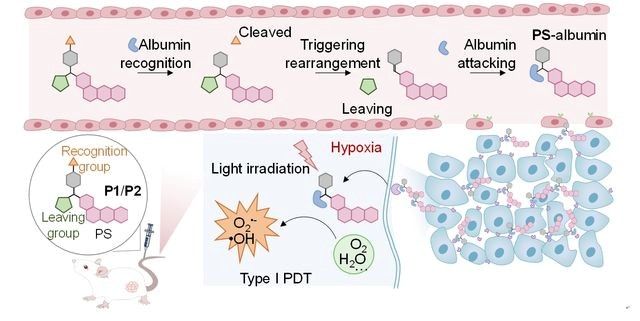
Currently, through the development of artificial carriers, photosensitizers can be effectively delivered and accumulated in tumor tissues by leveraging the enhanced permeability and retention (EPR) effect or active targeting modifications. However, multifunctional carriers still face serious challenges, such as uncertain long-term biosafety, limited biodegradability, and rapid clearance. In contrast, albumin, as a natural “stealth” carrier, possesses a long circulating half-life and intrinsic tumor‑homing ability via receptor‑mediated endocytosis, offering an attractive alternative. Nevertheless, existing albumin‑hijacking strategies mainly rely on ex vivo or in situ construction through covalent/non‑covalent binding, with several issues: (1) physical adsorption or hydrophobic binding leads to inadequate control over drug–albumin interactions and off‑target release; (2) ex vivo multi‑step synthesis results in reduced bioactivity, preparation difficulties, and irreproducible outcomes; (3) interference from certain substances (e.g., proteins) may occur when the therapeutic agent interacts with albumin after in vivo administration.
To address these challenges, the authors designed a small‑ligand‑modified hypoxia‑tolerant Type I photosensitizer molecule (P1) that lacks conventional targeting groups yet exhibits excellent tumor accumulation and overcomes intratumoral hypoxia for enhanced photoimmunotherapy. P1 comprises a ligand composed of 4‑hydroxymandelic acid, an acetyl group, and a leaving group. The phenolic hydroxyl group is capped with an acetyl unit as an albumin recognition moiety, and ferrocene is attached to the benzylic hydroxyl group as a leaving group, along with a hypoxia‑tolerant photosensitizer functional unit. Meanwhile, P2 (positive control) was designed by replacing the ferrocene in P1 with ethylamine. Two additional control probes were also designed: P3, which has the acetyl group but no leaving group; and P4, which has neither the acetyl nor the leaving group, serving as a negative control. Upon interaction with albumin, P1 undergoes deacetylation followed by 1,6‑rearrangement/elimination to form a quinone methide (QM). This QM is captured by albumin to form an adduct, as confirmed by HPLC, mass spectrometry, and absorption spectroscopy. Interestingly, fluorescence imaging showed that, after tail‑vein injection of the probes, P1/P2 exhibited enhanced accumulation in the 4T1 mouse tumor model compared to P3/P4. P1 also achieved excellent tumor targeting in tumor models derived from HepG2, CT26, and ID8 cell lines. Under laser irradiation, P1‑mediated photodynamic therapy (PDT) achieved breast tumor inhibition (~92% inhibition rate) by directly ablating primary tumors. Furthermore, in combination with PD‑L1 blockade, photoimmunotherapy suppressed both primary and distant tumors (both with ~95% inhibition rates). This work challenges the conventional paradigm that tumor targeting necessarily relies on ligand–receptor interactions, providing not only a simple yet powerful molecular design for tumor‑targeted, oxygen‑independent photodynamic agents for photoimmunotherapy but also advancing a new paradigm for enhanced drug delivery.
The first and corresponding author of this article is Professor Xiaofeng Wu (Young Chair Professor) from the State Key Laboratory of Digital Medical Engineering / School of Biological Science and Medical Engineering, Southeast University. Professor Juyoung Yoon from Ewha Womans University, Associate Professor Jingjing Hu from China University of Geosciences (Wuhan), and Professor Gaolin Liang (Chair Professor of Southeast University / Deputy Director of the State Key Laboratory of Digital Medical Engineering) are the co‑corresponding authors. Southeast University is the first affiliation. This research was supported by the start‑up fund of Southeast University, theYoung Scientists Fund (Category C) of the National Natural Science Foundation of China, and key projects.
Link to the article: https://pubs.acs.org/doi/10.1021/jacs.5c16988
