

As a new generation of nanozymes, single-atom nanozymes (SAzymes) offer advantages such as maximized atom utilization and precisely tunable metal–support interactions, demonstrating exceptional catalytic performance in biomedical fields including disease diagnosis, tumor therapy, antibacterial treatment, and antioxidant stress therapy. However, stability issues have become a critical bottleneck restricting their clinical translation. These issues include metal atom clustering and active site loss, ligand bond breakage at high temperatures, insufficient environment tolerance, biosecurity risks, and limited catalytic long‑term stability. Elucidating the underlying mechanisms of these stability challenges and developing targeted solutions are of great significance for advancing the practical application of SAzymes.
Recently, the teams of Zhang Yu and Wu Hao’an from Southeast University, in collaboration with Jing Ziwei from Zhengzhou University, published a review article entitled "Innovative strategies to overcome stability challenges of single-atom nanozymes" in Nano-Micro Letters. The article systematically addresses the stability challenges of single-atom nanozymes (SAzymes) and proposes innovative solutions, laying an important theoretical foundation for transitioning SAzymes from laboratory research to clinical applications.
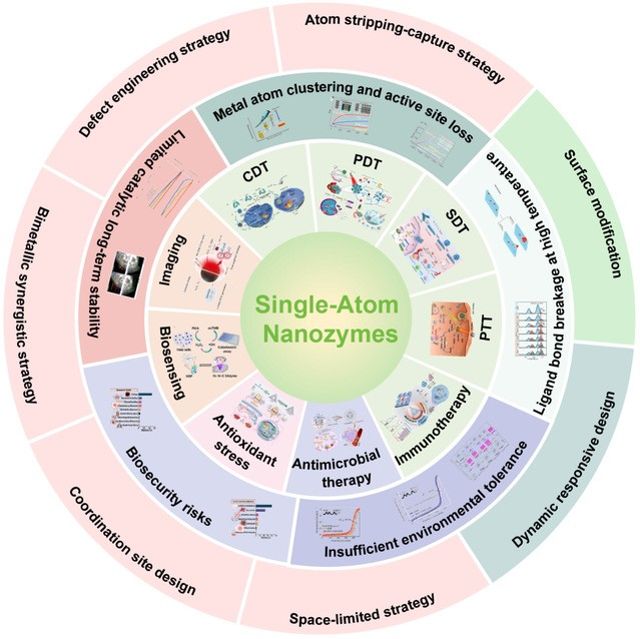
Stability Challenges of Single-Atom Nanozymes and Innovative Solutions
I. Systematic analysis of stability challenges of single-atom nanozymes
The research team comprehensively summarized five major stability challenges encountered during the application of SAzymes:
1.Due to high surface free energy, metal atoms tend to migrate and aggregate (clustering) during catalytic reactions or long-term storage, leading to a reduction in active site density.
2.Under high-temperature conditions, the kinetic energy of metal atoms increases, ligand bonds are prone to breakage, and the metal–support interaction is weakened.
3.In complex environments such as strong acids, strong bases, or highly oxidizing media, metal–ligand bonds are easily weakened and the support structure is prone to corrosion.
4.Non-degradable supports may cause inflammation or immune responses in vivo, while long-term leakage of metal ions poses a risk of cumulative toxicity.
5.Lacking the protective mechanisms of natural enzymes, SAzymes are susceptible to external factors and may lose activity during long-term catalysis and storage.
II. Innovative strategies to enhance stability
To address the above challenges, the research team proposed three major categories of innovative solutions:
1.Synthesis process optimization: including space‑limited strategy (using the pore size of porous materials to spatially isolate metal atoms), coordination site design strategy (enhancing metal–support interactions through axial coordination modification, heteroatom doping, etc.), bimetallic synergistic strategy (optimizing catalytic performance and stability via electron transfer between two metals), defect engineering strategy (constructing defect sites on supports to anchor single metal atoms), and atom stripping‑capture strategy (extracting metal atoms from nanoparticles or bulk metals and anchoring them as single atoms).
2.Surface modification techniques: using targeting molecules such as aptamers, antibodies, and peptides to modify SAzymes for precise delivery and reduced off-target accumulation; utilizing natural materials as templates to improve biocompatibility and facilitate metabolic clearance.
3.Dynamic responsive design: constructing pH‑, light‑, or enzyme‑responsive SAzymes to enable on‑demand switching or amplification of catalytic activity, tailored for specific application scenarios such as the tumor microenvironment.
III. Application prospects and future directions
The review summarizes the diverse biomedical applications of SAzymes, including biosensing, diagnostic imaging, chemodynamic therapy, photodynamic therapy, sonodynamic therapy, photothermal therapy, and immunotherapy for tumors. The research team proposes a four‑dimensional roadmap for the future: "structure predictable, activity tunable, biocompatible, and scalable." Combined with AI technology to optimize drug delivery system design, this approach aims to further enhance the stability and application efficacy of SAzymes, transforming them from "star materials" in the laboratory into clinical tools for precision medicine. (Reviewed by the School of Biological Science and Medical Engineering)
Article link: https://doi.org/10.1007/s40820-025-01939-2
