

Currently, the vast majority of studies evaluate the catalytic performance of nanozymes based on their activity over short time scales (seconds/minutes). However, in many practical biomedical scenarios (e.g., tumor therapy, wound healing), nanozymes are required to function continuously over longer durations (hours/days). Therefore, investigating the long-term catalytic behavior of nanozymes and assessing their stability and sustainability is particularly important. Moreover, scalable preparation of nanozymes is the foundation for their industrialization. Flow-based preparation using microfluidic channels is currently a research hotspot in nanomaterial synthesis. This technology enables batch production of nanomaterials simply by extending product collection time or increasing the number of parallel channels, without suffering from scale-up effects. Thus, developing flow chemistry-based synthesis methods for nanozymes is expected to accelerate their industrialization process.
Recently, the group of Professor Zhang Yu at Southeast University developed a simple, rapid, and controllable flow-based batch preparation method for nanozymes and elucidated the long-term catalase-like (CAT) catalytic mechanism of a series of nanozymes. By tuning various reaction conditions within microfluidic channels, this work achieved rapid synthesis of common CAT‑like nanozymes including Prussian blue (PB), manganese Prussian blue (Mn-PB), Fe₃O₄, CeO₂, Pt, and Au. The developed setup enabled batch production of 60.5 g of uniform, crystalline PB nanozymes within 115 minutes. Furthermore, the study investigated the activity changes of these six nanozymes after prolonged CAT‑like catalysis. It was found that irreversible surface oxidation of nanozymes during catalysis is a key factor affecting their catalytic reaction energy profile, leading to either self‑enhancement or self‑depletion of catalytic activity. This finding highlights the guiding significance of long‑term catalysis studies for both mechanistic understanding and application design of nanozymes.
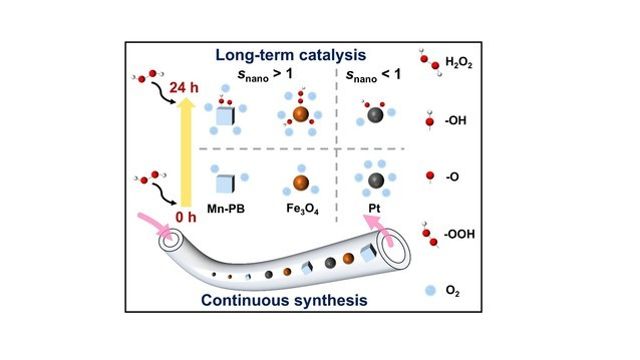
Schematic illustration of flow preparation and long-term catalysis of nanozymes.
This work, titled “Exploring the Long-term Catalytic Mechanism of Catalase-like Nanozymes Prepared by Flow Chemistry,” has been published in Advanced Functional Materials. Doctoral student Feng Kaizheng from the School of Biological Science and Medical Engineering at Southeast University and Associate Professor Wang Zhenzhen from the National Center for Nanoscience and Technology are co‑first authors. Professors Zhang Yu, Ma Ming, and Wu Hao’an from Southeast University, along with Professor Gao Xingfa from the National Center for Nanoscience and Technology, are co‑corresponding authors. (Reviewed by the School of Biological Science and Medical Engineering)
